Perfect Product Photography at Gulfood 2026 — Exhibition Lighting Dubai
Exhibition lighting Dubai: Why lighting is your single biggest visual ROI at Gulfood 2026
Exhibition lighting Dubai is the single biggest visual ROI you can buy at Gulfood 2026. With organiser projections exceeding 100,000 trade visitors across DWTC and DEC and thousands of exhibitors, the attention window on the show floor is measured in seconds. Professional product photography and content created on-stand convert that fleeting attention into post-show sales, PR placements and influencer reach — often at a 10–30% premium for brands that guarantee visual quality.
- Buyer attention is compressed: visitors scan aisles quickly; standout product photos are the asset that extends momentum after the show.
- Scale amplifies impact: with social and press coverage tied to high-quality images, poor lighting costs you missed placements and extra post-production fees.
- Post-show ROI: professional photography delivers assets for e-commerce, press kits and influencer campaigns that often pay back the lighting investment within weeks.
Exhibition lighting Dubai: Technical constraints you must solve now (rigging, power, DCD, LED refresh)
Address technical constraints well before arrival. The two venues for Gulfood 2026 — Dubai World Trade Centre (DWTC) and the Dubai Exhibition Centre (DEC) — have different rigging regimes and both require engineered submissions for flown or heavy overhead rigs.
Rigging and engineered submissions
- DWTC enforces tighter ceiling grid limits and requires early booking of primary rigging points through the official contractor.
- DEC allows higher load points but still insists on structural sign-off for flown AV or overhead lighting above 2.5m.
- All tall or heavy flown elements must be accompanied by engineered shop drawings and structural calculations.
Electrical orders, CEE and three-phase power
- Order three‑phase and 24‑hour power during the early-bird window. Late orders commonly attract 20–50% surcharges or may be unavailable.
- Specify CEE connectors and expected amperage: common installs use 16A or 32A three‑phase CEE supplies for consistent power delivery.
- Plan for power-inrush of LED drivers; uncontrolled inrush can trip breakers — we always specify soft-start drivers or dedicated circuits for large arrays.
DCD fire-rating and LED refresh
- Dubai Civil Defence (DCD) requires certified fire-rated materials for claddings and suspended housings. Provide fire certificates with submissions.
- Test LED panel refresh against camera shutter speeds to prevent flicker. Bench-test drivers at expected dimming values and at camera frame rates commonly used for stills and video (shutter speeds from 1/50s to 1/2000s).
Exhibition lighting Dubai: Common exhibitor lighting mistakes that kill product photography
- Low CRI fixtures and mixed colour temperatures — these flatten colour and make food look unappetising. Use CRI ≥90 and keep Kelvin consistent across the stand (recommended 3000–4000K for food).
- Wrong beam angles — too narrow (e.g., 10–15°) creates hotspots; too wide (60°+) removes modelling. Use focal spot options: 15°, 25°, 40° for product highlights and 60° for general washes.
- Specular glare and reflections — package gloss and metal will blow out if specular angles are not controlled; include flags, baffles and polarising techniques in your plan.
- Unsequenced LED panels and incorrect driver settings — cause subtle flicker on camera even when invisible to the eye.
- Late technical orders — arriving without booked rigging points or adequate power often forces scope cuts and compromises photography setups.
Exhibition lighting Dubai: Burdak’s pre-assembly mock-up solution — step-by-step technical fix
We solve these constraints with a factory-first approach. Our UAE-based in-house fabrication and CNC joinery let us produce fully tested, ready-to-install lighting systems.
1. In‑house fabrication & CNC joinery
- We build bespoke lamp housings, baffles and mounts from DCD‑approved materials and finish them to match stand aesthetics.
- Materials are selected and certified to meet local fire-rating requirements; finishes are applied in controlled environments to avoid contamination that might invalidate certificates.
2. Full‑scale pre-assembly and camera testing
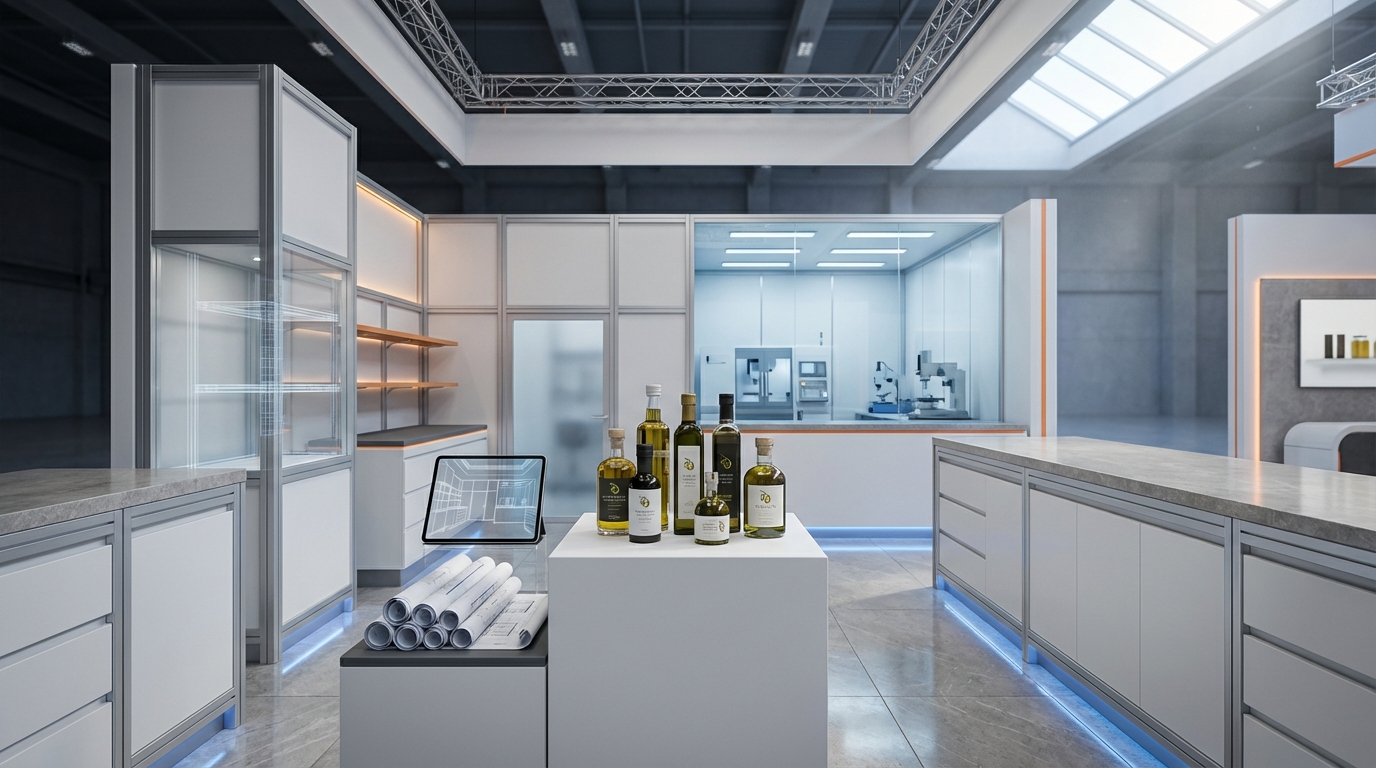
- In our warehouse mock‑up we replicate stand dimensions and ceiling heights. We test CRI, Kelvin and beam angles on-camera with your photographer and creative lead.
- We bench-test LED refresh rates against common camera shutter speeds to eliminate flicker and perform power-inrush testing to check breaker stability.
3. Engineered shop drawings & RAMS
- We produce DWTC/DEC-ready engineered drawings, structural sign-off packages and RAMS (Risk Assessments & Method Statements) for direct submission to venue authorities.
- These documents streamline approvals for rigging points and electrical connections and avoid on-site hold-ups.
4. Staged delivery & labelled crates
- We sequence crates and label every part to match marshalling slots and install order. This reduces yard time and prevents the common last‑minute rework that kills shoot schedules.
- Data from our projects shows full‑scale pre-assembly cuts on-site build time by 40–60% and materially reduces demo/photography failures.
Exhibition lighting Dubai: 7-point checklist to guarantee photo-ready lighting for your Gulfood stand
- Confirm venue & hall (DWTC vs DEC) and rigging limits; book points early.
- Order required power drops (24‑hour/three‑phase) in the early-bird window to avoid surcharges.
- Insist on high-CRI (≥90) fixtures and consistent colour temperature across the stand (3000–4000K recommended).
- Pre-approve LED refresh & camera test at a factory mock‑up with your photographer/creative lead to eliminate flicker.
- Submit engineered drawings, RAMS and fire-test certificates on schedule for DWTC/DEC approval.
- Label crates and schedule staged delivery aligned with marshalling time-slots to avoid yard delays.
- Schedule a final on-site tech walkthrough and designate an on-call Burdak technician available during opening hours.
FAQ — Exhibition lighting Dubai & Gulfood 2026
Q: What venue-specific rigging differences should I know?
A: DWTC enforces tighter ceiling grid limits and requires primary rigging booked through the official contractor; DEC offers higher loads but both need engineered submissions and structural sign-off for flown elements above 2.5m.
Q: How early should I order power?
A: Place three‑phase and 24‑hour power orders in the early-bird window. Late orders often incur 20–50% surcharges or risk non-availability.
Q: What CRI and colour temperature do you recommend for food/product photography?
A: Use fixtures with CRI ≥90. For food, 3000–4000K provides the best balance between warm tones and natural whites; keep the whole stand on one Kelvin temperature to avoid mixed lighting.
Q: How do you prevent LED flicker on camera?
A: We bench-test LED refresh rates and drivers at the factory mock-up across typical camera shutter speeds. We specify appropriate drivers (high-frequency PWM or linear drivers) and soft-start circuits to manage power-inrush.
Q: What advantages does Burdak offer?
A: We provide UAE-based in-house fabrication, CNC precision joinery, full-scale 3D mock-ups and pre-assembly, DWTC/DEC-ready engineered drawings and sequenced, labelled crate delivery. This removes last‑mile surprises and guarantees photo-ready lighting.
If you’re exhibiting at Gulfood 2026, contact us early — we’ll run a mock-up with your photographer, produce the engineered submissions and deliver a plug-and-play lighting system that converts on-stand attention into high-value photographic assets.